
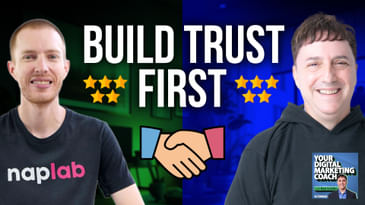
Ever wonder how someone goes from frustrated agency employee to building a trusted content empire? Derek from NapLab shares his remarkable journey of turning a terrible mattress shopping experience into a business that replaced his salary in just two months.
In this episode, you'll discover Derek's "create what you wished existed" approach to content strategy, why he started testing mattresses in a cramped one-bedroom apartment with nothing but a cell phone and lamp lighting, and how this humble beginning led to one of the most trusted review sites in the mattress industry.
Key takeaways from this conversation:
- How to identify profitable content opportunities from your own consumer frustrations
- Why starting imperfectly beats waiting for the right equipment or skills
- The simple transparency strategy that builds more trust than any sales funnel
- How to monetize content without compromising your integrity or audience trust
- Derek's approach to weathering Google algorithm updates by focusing on authenticity
- Why saying no to sponsored content actually increased his revenue
- The North Star mindset that guides every piece of content he creates
Derek's story proves that authenticity and genuine problem-solving will always win over flashy marketing tactics. Whether you're a content creator, entrepreneur, or business owner looking to build trust with your audience, this episode offers a blueprint for turning your expertise into sustainable income while maintaining your integrity.
Connect with Derek at NapLab.com or find him on LinkedIn.
Learn More:
- Buy Digital Threads: https://nealschaffer.com/digitalthreadsamazon
- Buy Maximizing LinkedIn for Business Growth: https://nealschaffer.com/maximizinglinkedinamazon
- Join My Digital First Mastermind: https://nealschaffer.com/membership/
- Learn about My Fractional CMO Consulting Services: https://nealschaffer.com/cmo
- Download My Free Ebooks Here: https://nealschaffer.com/books/
- Subscribe to my YouTube Channel: https://youtube.com/nealschaffer
- All My Podcast Show Notes: https://podcast.nealschaffer.com
[00:00:00] What if your biggest consumer frustration could become your most profitable business idea? That's exactly what happened to today's guest, Derek Hales, who turned his terrible mattress shopping experience into a content empire that replaced his agency salary in just 2 months. He's going to share the simple mindset shift that helped him identify his niche, why refusing easy money actually made him more money,
[00:00:27] and the one content strategy that's kept him thriving through every Google algorithm change. If you've ever wondered how to turn your expertise into authentic content that people actually want to consume, you'll want to make sure to stay tuned for this next episode of the Your Digital Marketing Coach Podcast.
[00:00:57] See email marketing. Whew! There's a lot to cover. Whether you're a marketing professional, entrepreneur, or business owner, you need someone you can rely on for expert advice. Good thing you've got Neal on your side. Because Neal Schaffer is your digital marketing coach. Helping you grow your business with digital-first marketing, one episode at a time.
[00:01:27] This is your digital marketing coach. And this is Neal Schaffer. Hey, everybody. This is Neal Schaffer. Welcome to episode number 433 of my Your Digital Marketing Coach Podcast. You know, a lot of people reach out to be on this podcast. And when it's someone that I don't know, I tend to look for certain things. I interview a lot of people that I do know, like authors or someone that have something very public
[00:01:56] that I can sort of look into what they did and how they did it. So when Derek reached out to me, today's guest, he had this incredible story of a consumer on a journey who had become not just a content creator, but an extremely content creator that I think we, both content creators and business owners and entrepreneurs, can all learn a heck of a lot from. And the funny thing is, the issue that brought him to begin that journey is the exact same issue that I, as a consumer, am going through right now.
[00:02:24] Derek went from being a disgruntled digital marketing agency employee to building NAPLAB, one of the most trusted mattress review sites on the internet. But here's what you'll learn from his story. How to identify content opportunities from your own consumer experiences? Why starting with basic tools and improving over time beats waiting for perfection? And how transparency and authenticity can become your biggest competitive advantage?
[00:02:50] You'll discover his approach to building trust that converts better than any sales funnel. How to weather algorithm changes by focusing on what actually matters and why saying no to easy money can be the smartest business decision you'll ever make. Without further ado, let's jump into my interview with Derek Hales from NAPLAB. You're listening to Your Digital Marketing Coach. This is Neil Schaefer.
[00:03:18] Derek, welcome to the Your Digital Marketing Coach podcast. Thank you so much for having me. You know, a lot of people reach out to be on this podcast. And there's certain things I look for when I look at a pitch, when it's someone that I don't know. I tend to interview a lot of people that I do know or authors or someone that have something very, very public that I can sort of look into what they did and how they did it. So when Derek reached out to me, he had a great story.
[00:03:45] And it was a story of a consumer on a journey. And from that journey, he basically became a content creator. And the funny thing is, the issue that brought him to begin that journey is the exact same issue that I'm going through. So I'm going to ask for his personal advice after the show is over. But Derek, welcome again to the podcast. And I'm sure a lot of my listeners do not know you. So I'd love for you to just tell us a little bit about yourself and what brought you on this journey.
[00:04:11] Because I know you went from sort of marketing, disgruntled marketing agency employee to content creator and owner of your own domain. So let's hear the story. Yeah. So I guess my story kind of started, you know, at a digital marketing agency straight out of college. I began working for a major firm that did SEO and other digital marketing services. And first couple of years there was great. I learned a lot, was really enjoying the job, working with some really cool and interesting brands.
[00:04:38] And the second two years, kind of not so good, more frustrating than it was fun. I wasn't learning as much. And so pretty quickly, I was just kind of looking at what were kind of my other options out there. Could I jump ship to a different agency or a different industry? But at that time, I also just wanted to kind of sharpen my own skills. You know, in high school and in college, I did kind of my own web design and I had my own websites, blogs. And so I really enjoyed that work.
[00:05:06] And so I wanted to kind of cut my teeth again, sort of remind myself how to do that. And so really, it's kind of like a weekend hobby project. I put up a website with some mattress reviews and comparisons. My wife had kind of gone, my wife and I went through this process of shopping for a mattress. We did sort of the whole in-store thing, went in, tried a bunch of beds, found stuff we liked, but we couldn't stomach the $5,000 price tag. So we took a swing on some of these new online mattresses.
[00:05:33] I mean, they were, you know, not perfect, but good enough and inexpensive with great return policies. So I had sort of finished this mattress shopping experience. I wanted to build this website. So again, we did kind of some reviews, comparisons, some FAQs, just kind of walking through like what I went through and the process of buying a new mattress and threw this website up. And almost immediately, it was apparent it had really struck a chord with a lot of people.
[00:05:59] Traffic was really exploding in a way that I had never seen a site so young do so well. So it was clearly something that people were interested in. Our readers kept asking for more reviews. We kept doing more reviews and within six months, I was ready to make the leap from my agency job over to kind of full-time content creator and mattress tester. Amazing. What an amazing, inspirational story that hopefully a lot of you listening will resonate with. You know, agency is very funny.
[00:06:28] When I mentor, you know, young marketers, agency is not easy, but you get a lot of experience really fast. And I think the successful people that I know in their early career have gone back and forth between agency and brand, agency and brand. They get the best of the both worlds, but you basically created your own brand. So now obviously it began with this experience. I think we've all had experiences where we do research and we feel like we're an expert on something. And why don't we go the extra mile of sharing that?
[00:06:55] Now you had website development experience. So maybe a lot of people here listening aren't able to like throw up a website on a weekend. Obviously, you know, TikTok, Instagram, LinkedIn, make social media your website. But when you put this up, are you developing it like HTML, JavaScript, which is like a WordPress or let's get a little techie. What was sort of the, if someone's listening and wanted to know, Hey, I want to put up a site like this. What was involved from a technical perspective? So it was just a WordPress installation.
[00:07:23] So we got ourselves a domain on GoDaddy or wherever. We set up WordPress, really, really simple stuff. And so I've been basically exclusively building on WordPress since college. So 2009, I think before that, I had tried Joomla and Drupal and a few other platforms and CMS, and they all have their pros and cons. And there's certainly more options today, but I think WordPress still remains like the
[00:07:48] best in class as far as it's a little bit more to get going and learn sort of the ecosystem. But once you do, you can, you can do anything. Yeah. I've been on WordPress since 2008 myself, big fan. And so you were able to find a theme and plugins that allowed you to build this review site with search filters. And, you know, it doesn't look like a normal WordPress site, which is why I'm asking, but all that is available is what you're saying. Yes. Yes.
[00:08:14] And I should clarify to NAP Lab today does not look like my, my initial site in 2014. So I'm sure the 2014 site was very, you know, kind of blog really. I mean, it had some extra stuff, but it was fairly simple, but yes, even NAP Lab runs on WordPress. And so, you know, over the years we've sort of, you know, refined our development and themes. And then the way that we, you know, do content and taxonomies to make it is really sort of immersive and engaging experience, but it's still fundamentally just runs on a, on a WordPress
[00:08:44] install. Awesome. And by the way, Derek is extremely, extremely modest, but the name of the website is NAP Lab. So feel free as you listen, as you watch to open a second tab, because I know we're all sort of HD, HD-ish and check it out while we're talking to get an understanding of what he built. That's N-A-P-L-A-B. So Derek, getting back to the conversation, you started on, it sounded like at the beginning, it was more of a passion project and you really weren't sure about monetization. Is that a correct assumption?
[00:09:12] Or were you thinking, because back in 2014, we didn't, we weren't talking about the creator economy, which we really only started talking about with COVID. Social media was still in its early days and blogs were still huge. So I'm curious, what were your, were your initial thoughts or we'll just build and figure it out or passion project, or this is my key to, you know, leaving the agency? Yeah, it was, it was certainly not my key to leaving the agency. My whole goal was just, I wanted to, again, just kind of like sharpen my skills, you know,
[00:09:40] four years in an agency, you do a lot of documents, a lot of calls, a lot of meetings, but you don't do a lot of doing. I wasn't building websites. I wasn't going in and actually doing the types of optimizations that we needed to make for search. I wasn't, you know, going in and improving page beat performance by actually getting into the code. Um, so I had kind of lost those skills or rather they were, they were rusty. And so I hadn't done those things since college. So really just want to kind of build something where I could, again, just remind myself, here's how we build a website.
[00:10:10] These are the plugins that, that are, you know, kind of popular and are going to be effective for today's market. And just, again, just remind myself how to build a website to kind of just give myself some options. I kind of felt that my time was ending at the agency. And even if I wasn't able to sort of make the leap into, you know, content creator with, with NAP lab, I was going to go somewhere. And so having, you know, more skills and more options was kind of my thought at that time. Yeah. Just a great mindset that, you know, lifelong learner.
[00:10:39] And I encourage everyone listening, whether you're happy or not at your job, you always want to be sharpening your skills. And the best way to do it is either on your personal brand. In your case, you created this new brand or, you know, volunteer with a nonprofit, help them with their marketing. They could always use the help. But Derek, so at the beginning, you were not thinking about monetization. And I'm assuming as I did with my own blog, you started having people, businesses reach out to you that wanted a piece of your platform.
[00:11:06] So how did that begin this, the efforts towards monetization? Was it purely passive? Were you reaching out to, you know, mattress manufacturers, little combination or, or what was the story there? Initially, the monetization was really simple. It was just referral links. And I mean, just simple referral links. So affiliate marketing, basically. Yes. Yes. So the initial brands that we tested, you know, they have basically friends and family referral programs. So when you buy, they would send you a little signup link, and then you could send that
[00:11:35] over to friends and family. And so instead of friends and family, I was just putting it up on the website. And so when people would come, they could, you know, get $50 off the mattress, and then that would get a referral back for the site. And so that was really how it began. Within just, again, a few weeks, we were getting noticed by other mattress brands and manufacturers that were wanting their mattresses to be reviewed. So they were saying, hey, can we send you a bed? Can we set up a referral program? It's like, sure, we'd be happy to test it.
[00:12:02] And so we were, you know, very quickly overwhelmed with more requests than we could take. And so we were just, brands would send us stuff, we would test it, we put the review up, we added some comparisons, we would put it on our best of list if it earned a spot. And then we monetized the whole thing with referral and affiliate links. So did you create like a mattress lab in a warehouse somewhere? Or are you literally in your house with your, you know, with your partner's approval, you were switching out mattresses, basically on a weekly basis?
[00:12:32] Yes, it was that one. So the business started in a, you know, a 950 square foot, one bedroom apartment in Arizona. And so my wife and I would just move the mattresses from night to night. At the peak, we got up to 17 king size mattresses in that apartment. We had them, they were in the hallway. They were in our living room was 60% mattress. Then we had a little corner where we had our TV and stuff.
[00:13:01] They were in my kitchen, they were in my office. And so by the time we hit 17, it's like, all right, we, we need a new place, we need a bigger place. But the first basically year of the business was just this, this one bedroom apartment and we would swap out mattresses. Initially our, our equipment, our lighting was very bad. You know, it's my, my wife is in the corner of the room with a cell phone trying to take video of me as I just sort of fumble my way through a spoken review with no script, just
[00:13:31] freestyling it. So we learned a lot in that first year about what not to do by doing a bunch of things that were kind of mediocre and not so good. But even as sort of mediocre as it all started, I think it, it's still, it felt, you know, and it felt, and it was, it was real, it was authentic. And I think that, that level of almost it's so bad, it can't possibly be fake. I think helped us establish ourselves as, as a trusted voice in the world of mattress reviews.
[00:13:59] So you mentioned video. So I just want to get to, you know, the actual content creation, WordPress blog, you know, I'm assuming, you know, written reviews, like every review is a blog post. And were you adding images in the blog and you also had a review that you were posting on YouTube and embedding in the blog post or what did that look like? Exactly. So we, we always start with a contextual review and we always do a full set of, of photographs of the mattress. So they can see here's what the materials look like. Here's what the build quality looks like.
[00:14:29] Here's what I look like when we're sitting on it, when we're laying on it, here's what that support dynamic looks like. And other, you know, photographs just to help a user and reader experience this mattress as much as they can through the contextual content and through the photographs. And then once we have that all done, then we basically turn all of that into a video. And so we go and we shoot the script, shoot the video, shoot a bunch of B-roll, and then edit that into something that, you know, felt both entertaining and interesting to watch.
[00:14:57] And of course, extremely informative as well. Gotcha. So we might have some listeners said, okay, WordPress check, blog check, photos check, video. It sounds like you did this all yourself. And I think maybe that was another skill you picked up in high school. Were these shot using a professional camera, using, you know, professional software or how sort of down and dirty was the process? In the early days, it was, it was very, very dirty. It was literally a cell phone with lamp lighting.
[00:15:26] That, that was it. If you, I'm sure you can, if you, some of those videos are probably still out there. As I said earlier, they, they were not good. They were not good videos. We didn't have like a script or a whole lot of structure. I had kind of the thoughts in my head about what this bed was like, what my experience was like. And we just talked through those. And then I would demonstrate different things on the mattress as far as sinkage and hug and bounce and the types of, you know, performance criteria that people find helpful and interesting with respect to mattresses.
[00:15:55] Over time, you know, our content is improved both in terms of, you know, our photos or architectural and our video. So our equipment is improved, our process is improved, the way we edit our, our B-roll, our graphics. And so it has been a very gradual process, but we started with, with very humble origins. It was, I want to say probably a year, 14, 15 months after we launched that we, we finally got ourselves some like decent lighting, a proper, you know, DSLR camera.
[00:16:23] I think we started with a Panasonic GH4, which was a great camera for many years, you know, a real lav mic. And so these were like huge, huge upgrades for us, you know, going from shooting with basically no lighting, lamp lighting and a cell phone. But really it was, it was humble origins that we just gradually improved. And even today we're, we're always looking for ways to further improve and refine our process. Yeah. And you mentioned the video editing. So just for the listeners, what software, because CapCut, you know, didn't exist back then.
[00:16:53] You don't have the AI tools like Opus Pro back then. So I'm assuming you had to use sort of a more complex software, but now it's a lot easier, correct? Yeah. So initially we started with Sony Vegas Pro. I was doing all my own editing initially in high school and college. I had used Sony Vegas Pro. So I had a good level of just experience with that. Relatively quickly, we moved over to Premiere and, you know, I needed to hire an editor just help, you know, just with the quantity of videos that we were doing.
[00:17:20] But also in the, in the beginning, our video editing was, was very simple. You know, we're just a few quick cuts, put like an intro, put an outro. And that's one of those things that's gotten very complex. Our videos today are, you know, a thousand fold more complex than they were in that first year. So we try and do a lot more with graphics and really, you know, fine tune, you know, B-roll and closeup shots and demonstration shots to really, again, just let our viewers experience the mattress in a meaningful way. Yeah. Well put.
[00:17:49] And I mean, just a few things there, you know, every famous YouTuber, even Mr. Beast says, Hey, my, my first hundred videos are like the worst, right? So you always get better over time. And the people that I know that end up, they want to do this. They end up like researching and buying really expensive equipment that they never use. I'd rather you do it exactly the way that you did it, Derek. So, you know, really well done. The video editing might be, you know, that there are services you can use obvious people on Fiverr. And as you said, Derek, and I thought that was really well said, which is, you know,
[00:18:19] yeah, we do B-roll and like intro outro, but it's really about helping the viewer better experience the product. So the problem that a lot of content creators have is they'll look at the YouTube videos of YouTubers and they are so well done and they try to emulate that and you really can't. And does it make sense to emulate it for your viewers? So I think we're starting to crack the code of your success here. One other thing, so you got the blog, you got YouTube. At that time, back in 2014, did social media play any role in all this or was it pure like blog YouTube?
[00:18:49] We had social accounts, but you know, I am not a social media guy. I really never have been. We've gotten better over time and try to be at least active on those platforms. So if people are coming, they're asking questions, you're adding us with comments, what we're there to answer and reply. But social media has never been a big piece of sort of my toolkit. And when businesses reached out to you, do you think it was from the blog, from YouTube for both?
[00:19:15] Were you able to sort of attribute those, you know, for lack of a better word, leads from one or the other channel? Or was it all just omni-channel mixed together at this point? I expect it's more omni-channel than anything else. But, you know, a number of brands would say, hey, we saw you ranking for this. And so they're monitoring, you know, their competitors. And if they see their competitor is, you know, ranking for some particular term, you know, they want to be present there as well and try to get products into the hands of reviewers that might be able to test and review them.
[00:19:45] Yeah. And, you know, it's the same for the listeners. It's the same as if you tag a brand on Instagram, they might notice you. Well, just by saying a brand's name in a blog post or in a YouTube video that goes into a transcript, it gets picked up. And inevitably, I've had the same thing where I, you know, I mentioned one brand and all of a sudden all the competitors reach out. So now at the beginning, it sounds like you were 100% affiliate. And fortunately for you, you were in a market where the average sales price, obviously those
[00:20:13] more expensive ones were in the thousands, but some of them I'm assuming were, you know, closer to 1,000, 2,000, maybe several hundred. So the affiliate income actually versus trying to, you know, sell a 20 or $30 pair of glasses, I'm assuming that obviously there's a lot to generate there. Were you able to build that business 100% from the affiliate income? I mean, how long did it take for the affiliate income? Because it takes time for people to decide, obviously. I mean, maybe what benefited you was that people were pretty close to the purchasing decision
[00:20:43] when they found you and they were looking at your content. So maybe that sales cycle was a lot shorter, but tell us about that monetization or how long it took for the affiliate revenues to get going and then how you diversified since then, if you have. Yeah. So we did not take very much time at all for the affiliate referral links to get going. Wow. Within, you know, two months of launching the site in 2014, I had replaced my income. Wow. That's amazing. I sat on it for another four months just because I was like, the floor has got to drop out.
[00:21:11] At some point, this can't continue, but it did. It continued. We hit the six month mark. You know, I had, you know, doubled my salary at that point. I was like, you know, I've, I'm going to regret this my entire life if I don't take a leap at this. So we, we had, you know, a little bit of a cushion in our savings account. And so I talked to my wife. I was like, listen, I want to give this a try for a year. Worst case scenario, this thing blows up tomorrow. I do it for a year and then I go back to the agency world, but it didn't.
[00:21:37] And so referral and affiliate link was always sort of how we monetize. And even today, it really represents the vast, vast bulk of our revenues. Wow. I really dislike sponsored content, advertorial content, pay to play, pay for play. I'm going to ask about that. Yeah. I'm sure that a lot of mattress brands reached out saying, Hey, you know, can we sponsor? Can you put us at the top of the list? Give us good rating. But that breaks away. I think one of the things we wanted to talk about today when we were prepping was that
[00:22:06] trust that you need to build with. And maybe this is a great segue into that topic, actually. Yeah, absolutely. And so I think, unfortunately, like that type of monetization is really ubiquitous in the world of reviews and especially in the world of mattress reviews. A lot of sites that did test and review mattresses really feel more like auction houses than they do review platforms because you go look at their best of page and it's just like, all right, well, this is just who's paying the most money.
[00:22:33] And it's pretty clear to like to see those players and then why they're in those placements. And so as a consumer, I hate that content. I just find it incredibly distasteful and unethical and I didn't want any part of it. And so just leaving us with exclusively referral and affiliate links, let us basically do our reviews, do our content, do our videos. And then we include the links and we have referral links for basically everything we review.
[00:23:01] And then, you know, whatever consumers end up buying, you know, we're going to, you know, make a commission on and be able to support the site financially. As we grew, we expanded a little bit, mostly on YouTube. You know, we make a little bit of money on YouTube ads, but it's, you know, just a drop in the bucket. We also, you know, accept donations from our readers and viewers, but again, just a drop in the bucket. So for an app lab, we've been able to make it work with referral links exclusively almost. So I want to get back to that topic of trust.
[00:23:31] And, you know, one of the things that you were saying when we were prepping for this was build trust first. Why should your readers trust anything you're saying? And I think in this world where we have a lot of content and even Google has, and we're going to get to Google's and AI in a bit here, but even Google has saying, Hey, make your, you know, make your web presence more branded, more trustworthy, a place where people want to come back to. Obviously we have EAT and trust.
[00:23:57] How does one go about, or how did you go about, I mean, recognizing the importance, kudos for that early on. How did you go about building that trust? Was it just a matter of having your voice, you know, in the video saying both the good and the bad about things, or was it just being a hundred percent honest, authentic? What were the steps that you took that others could emulate? Yeah. Looking back, it wasn't anything like intentionally that I was trying to do saying, okay, I'm going to do X, Y, and Z to make people trust me.
[00:24:24] I was just building the review that I wanted. And in that process, there was just a level of honesty and authenticity that comes through in, in the content. And so I think that was a major factor in that why people felt like they could trust what I was saying those horrendously awful videos I was making in that one bedroom apartment. No one's faking that. That is, that is, that's real. It's terrible, but it's real.
[00:24:53] And so you can trust the, the opinions are authentic and genuine. They might be misguided in some areas. And certainly we've, you know, improved again, our tests and our experience. We, and we're making better recommendations than ever, but even those early days, people could trust that what I was saying was what I genuinely believed. And so I think a big piece of earning trust is being authentic, being honest and creating something that is just fundamentally helpful to, to your readers.
[00:25:23] I think so often that people can, content creators and reviewers can get sort of so wrapped up and, oh, I need to, my site has to look like this, or my content has to hit these exact bullet points and criteria or my videos need to be shot in this way with this camera, with this lighting. And if there's not, then I, then I can't win. It's just, it's just not true. I think for me, and one thing I've always tried to do is just start with just a level
[00:25:49] of empathy and try to like empathize and understand what your readers are feeling and what they want, and then just give them that. And so for, for me, I was empathizing with myself thinking, what did I want? And then I made that thing. So I think we have sort of two major sort of pillars there. I think it's, one is the content side, making something that is trustworthy because it's authentic and honest and genuine.
[00:26:15] And I think the second side of building trust is operating ethically and transparently. I am a big believer in telling my audience exactly what I'm doing and how I'm doing it. So whether it's how we make money, where we include affiliate links, the free products that we receive for testing, the products that, that we purchase, the way that we score, the way that we test, the way those scores are tested, where mattresses appear on our best
[00:26:45] list and why, and why a brand might appear here or might not. We try to be just sort of obsessively upfront and transparent with information because I want my, my readers to see the site, to see our disclosures and not feel like they're being misled or pushed in a certain direction. It's just, I tell them here's, here's what we do. Here's how we do it. Here's why we do it. And in that process, I hope that we are able to earn the trust of our audience.
[00:27:14] Yeah, that's, that's very refreshing. I love, you know, what you said initially was create the content that I wish existed when I was in this situation. And it's such a great North star to have. And I think a lot of people, a lot of businesses forget that they try to make content for someone else, or they try to make content to fit in these silos when they should really think a little bit more simplistically. Right. But that the empathy, the transparency, that's all awesome. I mean, a lot of, uh, a lot of companies or, or these sites actually, they try to hide those disclosures, right.
[00:27:44] Where you want to build that trust and bring it up front. So that, that's just fantastic. And Derek, one thing I forgot to ask you, and you know, we were talking beforehand, I got the, you know, digital threads behind me was I asked you about the social media, not a big part, obviously blog, YouTube, big part. I'm curious if, if email, I'm assuming that once people buy a mattress, they're done. So they don't really want to keep in touch with you unless maybe they work in the industry. Did email marketing or having an email list ever play any part in this? Or were you able to just bypass it completely?
[00:28:12] I've tested, you know, sort of the, the traditional email list over the years and found it's just not something that my audience wants or, or likes. And so we've just basically stopped doing it. It was one of those things that was like, Oh, obviously you have to have an email list. You're, you're a blog, you're a website, you're a YouTube channel. God, I got to collect those leads. I got to build, build that list. But when people are buying mattresses every five to 10 years, they don't want to hear from you that often. And so it just, it just never made a whole lot of sense for us.
[00:28:40] Even so email is a big part of what we do at the top of, you know, the website, you can see our mattress finder quiz. It's a quick quiz. You go through, they answer a few questions about needs, preferences, budget that goes straight back to me where I analyze their preferences, needs, and budget, and then send them back a personalized email recommendation. So I'm not building a list there. It's not something that they subscribe to. It's just a manual. They send one email, I send one email back. And if they keep wanting to talk to me, I'll talk to them and answer their questions.
[00:29:09] But, you know, we try to provide, you know, that, you know, one-on-one customer support so that people really feel taken care of. That's amazing. I mean, there's obviously quiz software where you pre-program everything, you get the email address, you send them back something. So do you ever get bombarded with people taking that quiz and you having to spend a lot of time? And I understand that the ROI is, Hey, if one in 10 people end up buying, you know, mattress, it's going to be worth my time, however you value it.
[00:29:34] But what's, what's the ROI equation or you just never get that many people requesting it. I mean, what, what's been, I think that's really interesting for people that are afraid of the technology. There's a really down and dirty. Once again, the, the keyword for today's show of doing all this. So what's that experience been like? Definitely. So there are times when it has felt overwhelming. There were times when responding to those emails was a 40 hour a week job.
[00:29:58] So we had at one point we had just one dedicated employee who just did nothing but respond to emails. We have fortunately gotten much faster and efficient at, at handling large quantities of emails. We're getting more emails than, than ever before. And it really comes out to my wife. She is a true Google sheets and Excel wizard. And so we have a, basically a massive database of everything that we've ever tested with, you
[00:30:28] know, 43 different data points per mattress. And so when a user emails us and they say, okay, this is my budget. I want a medium. I want a memory foam and I want it to be firm and all these other things. We take that need automatically compare it to the entire database. And then it spits out and says, okay, that's probably, it's going to be this mattress. And then I go through that. I double check. I make sure, okay, here's what they said. That's correct. That is the mattress that they should get.
[00:30:54] And then we have, I mean, thousands of templates that I have written to respond to emails so that they're all personally written one time, but you know, I get the exact same, you know, you know, 200 questions again and again and again and again. So we would basically try to automatically match what they have asked for and then automatically create an email draft based on exactly what they need. And then that's verified manually.
[00:31:22] And then we're able to handle a huge volume of email while still being, you know, one-on-one and feel like it's really personal. And you've never been tempted to build this email list from those, you know, people in which many companies would do. You just felt that, you know, this had more value of having that one-on-one than dropping them into some mass emailing. I'm assuming. Yeah. I mean, again, part of it is after years of trying to make an email, a traditional email
[00:31:50] list work and nobody wanting it. It's just like, this is dumb. I'm just not, I'm not going to waste my time on this anymore. And part of it is just, I mean, right. The temptation to, you know, turn, you know, all of these people that have emailed me manually into a list. Again, would I want that? No, I would hate that. And so it makes sense that my users and my readers and my viewers would hate that. So I wouldn't want to do anything that I would hate. And I would absolutely never want to betray the trust of my audience. I mean, that's such a big thing.
[00:32:19] I'm very clear on that page. It's like, this is not a list. You're sending me one email. I'm sending you one email. If you talk to me after that, I'll keep talking to you. Otherwise you'll never hear from me again. Yeah. So at some point you end up hiring a full-time employee, as you said, just to respond to emails. How did you justify the ROI of that in your head? Because with affiliate, and I know that there are some, it's like, oh, you know, send me a receipt and I'll send you a thank you card or whatever, but you don't know whether they're actually going to purchase or did purchase.
[00:32:48] So you don't know what that actual income stream is from. So was it just at some point you take a leap of faith saying, you know, intrinsically, this has to be leading to building trust, to more affiliate revenue and even word of mouth where these people are like probably recommending your sites, their friend. What was that the mindset? Absolutely. And so I am definitely not like a reports or analytics guy. I would much rather spend time doing something than understanding what's going on.
[00:33:16] So, and I, again, we, we, we have, we have, you know, the reporting software and Google analytics and, and we do our best to like track and understand. But for me, it was, you know, I was seeing, you know, we have, we have good revenue. I don't need to understand exactly where every single sale is coming from because the truth is it's, it's omni-channel. You know, we have someone that would come in, read a review, click a link. Maybe they go by immediately. We have other people that come in. They read dozens of pages, hundreds of pages.
[00:33:46] They, they email us, they watch our videos. And then maybe they click a link in the YouTube description and that's where they make their final purchase. And so there's all these different channels and content avenues that are working together. And it's just so, you know, it's a, it's a one plus one equals three equation. I don't need to know exactly what piece of content pushed them over the edge because in my view, it's kind of irrelevant because for most people, it's going to be a combination of different things.
[00:34:13] And so trying to, to determine the exact ROI wasn't especially important. I knew we were making, you know, really solid revenue more than enough to justify, you know, the help there. And it was something where it was so clear that people liked this and wanted this other sites and companies don't generally do this type of one-on-one customer support. And so it made people feel good.
[00:34:37] It made people feel cared for, and it created, you know, just the best possible recommendation for them. So not only did they get a recommendation that is specifically tailored to them, they've now had this amazing experience with somebody that wants the best for them and is trying to deliver the, you know, the best possible mattress outcome. They're going to tell their friends, they're going to tell their family. And hopefully, you know, in five to 10 years, when sort of the mattress life cycle is up, they're going to remember us and come back. Yeah, that's amazing.
[00:35:07] Now, another thing you talked about when we were preparing was this exceeding expectation concept. And it sounds like that this quiz truly exceeded, I mean, the average internet user probably is not even going to expect a reply. And, you know, seeing your passionate reply with actual actionable and thoughtful advice must have really blown people away. So is that an example of when you say, always be trying to exceed reader expectations? Is that I mean, were there other things you were doing as well along those lines? Definitely.
[00:35:35] I think that's probably the biggest example is something that again, most types of companies don't want to do because it's time consuming. It's difficult. It's annoying. But absolutely, I think people are surprised to hear back at all. Surprised it's not automated. You know, every day I say, oh, oh, I thought you were a robot. Oh, I didn't realize this was an actual person. Or they'll say something, they'll put like an offensive name in the name field. And they'll be like, oh my God, I'm so sorry. I thought you were automated. I didn't realize this was a human. Like, no problem.
[00:36:05] No problem. So definitely, I think the personal one-on-one recommendations is a big part of exceeding expectations. For me, the other part is just like the depth of our content. And we've tested over 350 mattresses at NAPLAB at this point. And on every single one, we create 43 different data points and just go as hard as we can into the testing to try to help our readers really understand how these mattresses perform, how they compare to other mattresses.
[00:36:35] And then ultimately, like which is going to best meet their needs. So the level of content that we have tried to create on NAPLAB, I think, exceeds what most people expect and is far beyond what most other sites are doing. And I think this gets into one of your other North Stars. So one of them, to me at least, I'm creating these as we talk, but, you know, create something that I would have wanted when I was in the search.
[00:37:00] But the other thing that you mentioned as we were prepping was the concept of just, you know, solving readers' problems. And I know it sounds, of course, every piece of content we're creating is to solve the reader's problem. But really is it, right? Because when I look at a lot of businesses on site or even bloggers or content creators, maybe, you know, they're going after some trending music or they have some SEO keyword that might not be 100% relevant to your reader's problem.
[00:37:28] So, and I'm assuming, you know, we're going to talk a little bit about, you know, Google helpful content update and all that. But I'm assuming it's just so everybody should get it, but a lot of people don't. So maybe, maybe you could talk a little bit about that, about how that helped you guide you to be able to create the best content for your readers possible. Definitely. I think it goes right back to that North Star. It's like, what, what do I want? Identifying the pain points in the experience, I think for me was like the foundational step.
[00:37:56] And again, I didn't even realize I was doing this as I was doing it. I was, I was going into a mattress store being harangued by the sharks on, on the sales floor trying to be sold, you know, five and $6,000 mattresses when this high pressure environment thinking, God, this is just the word. I hate everything about this entire experience here in this store. And then I contrasted that to, I'm going out, I'm, I'm trying to find online options. I had one of my coworkers at the time recommended one of these bags, like, Oh, check this out.
[00:38:26] It's like $600 for a King. I was like $600. How will the world can that be? So I'm checking, checking out their site. It's cool. I'm going out there. I'm, I'm looking for reviews and there's just nothing. There's just nothing. Or what, what is a very amateurish and low quality and short and just not something that was actually useful for me. And those were the early days, right? 2014 in the, in the, uh, yeah. And it makes sense. I mean, not only was it early days for sort of bed in the box mattresses, but it was early
[00:38:55] days for really professional reviews at the time. You know, they just, you just didn't see that type of content at, at scale. And so again, I think for me, it was, it was having bad experiences that made me realize more clearly what a good experience would have been. Like I wanted a place where I could go, where I can see somebody who's put their hands on this, that they have the product themselves. They've done photos. They've done some testing. They've had an experience.
[00:39:23] They've explained succinctly and clearly and fully what this thing is like. And so that really set the foundation for kind of the early days of our content. And even today, like that has really continued. Now, the way that we test review today is, is very different than what we did in the early days. But now I have, you know, I've moved from less sort of subjective assessment of products
[00:39:48] into really like heavy data-driven testing, because I think it's something that is, it makes it easier for consumers and readers to understand and compare products when they can see that, okay, this thing has 0.3 seconds of response time. This thing has three seconds. And then it's, it's not a difficult leap for them, even if they can't put their hands or bodies on the product, they can say, okay, well, I don't like being stuck in a mattress.
[00:40:15] So I know I don't want something with, you know, a three second material recovery time or whether it's bounce or cooling or pressure relief or sex. We have all these different data elements that help us understand and quantify the product in a way that then makes the review just come to life in a way that it otherwise wouldn't. Wow. That's fantastic. So much that we can learn from your journey, Derek.
[00:40:40] And I want to fast forward to, we were talking before, we've had the Google helpful content update. We've had, you know, anti-spam measures, and then we have AI and AI overviews and generative engine optimization. Last two years has been really crazy. And for someone, obviously this hasn't affected the YouTube side as it has the search engine side, but for someone that I'm assuming has relied on a lot of search engine traffic to fuel your site, how have you seen the impacts? And most importantly, how have you pivoted that others might be able to learn from you from? Yeah.
[00:41:10] So as you said, I mean, last two years have been incredibly volatile in terms of the algorithmic updates. Really the last five years, I had more major updates since, you know, COVID times than probably the previous 15 years. So it's been really interesting. Most updates have been really helpful for us because most updates are clearing competitors out of the space and allowing us to climb higher and get more rankings in traffic.
[00:41:36] But we've seen, you know, times where we drifted down a little bit, you know, for a core update and then the next one comes out and then we go back up a little bit. But it's, I think anybody who relies on search traffic at any level, it can be a bit scary because you can feel like you're doing everything exactly the way you should and still, you know, sometimes, you know, lose your entire shirt. So I think understanding those updates is important. Knowing what they're doing and what they're trying to do is important.
[00:42:05] You should always be on top of those. Though I do think it's important to not over-optimize. And I think this kind of comes back to the North Star. You're making the thing that you want, not the thing that Google wants. And it's one of those things where when you make what you want, you're going to make a sizable subset of users want. When you make that, you're making what Google wants. So you're going to get there.
[00:42:31] But sometimes it can feel a bit scary to make something that's sort of outside of like the traditional sort of SEO. Like you got to do these things in this order and these placements and you got to build these links and you got to be on these platforms. And if you're not, you can never win. I don't really believe that. I think there's, you know, there's certainly some things that you have to do to get seen.
[00:42:50] But I think the most important thing to get seen and sort of to help insulate yourself from ranking fluctuations is creating something that is authentic and honest. Because that in a world of AI-driven content, that maybe is the only human thing sort of remaining on the horizon. The one thing that AI hasn't replicated yet.
[00:43:13] And so making it very clear that you are creating something that is not AI-driven, not automated, something that is, again, just honest and genuine and transparent, I think sets you up for much better success than the search engines. Yeah, that's amazing. So you really haven't, based on what you're talking about, you really haven't quote unquote pivoted in any way. And you're just continuing on in your journey with your North Star then. Is that a correct assumption?
[00:43:43] I mean, maybe some small tweaks here and there, but pretty much what you're doing today is pretty similar to what you did five years ago. Yeah, we made some adjustments when the helpful content, not the helpful content, when Google released their review guidelines. So I think it was 2020, they had guidelines for product views and they had a big, big long list of things that you should do. A lot of those things we were already doing. Some of those things was like, oh, we could do this better. Like this makes sense.
[00:44:08] Like if we're able to do this, like not only is Google saying they want this, but like this makes sense for our tests. It makes sense for our readers. And so we, you know, structured sort of our templates around that. And then as far as like building out the content of the templates, you know, that we're just getting back to, you know, our North Star. I build what I think I would want and I don't worry about that.
[00:44:30] But so much of our sort of SEO, if you will, is just foundationally built into our templates and sort of the WordPress plugins that we use. And so, you know, I'm not trying to like optimize our content. I just build the content. We do the test. We do the reviews. And it's got enough sort of foundational SEO that it's going to rank well because it is content that's made for our readers. And that's who Google, I think, that remains their sort of chief customer as well.
[00:45:00] I think when people searching for, you know, terms are arriving on our site and having a good experience, Google sees that. And it's just a feedback loop. It just keeps up and up and up. And as we've grown and expanded our rankings and expanded our content, whether it's on YouTube or social or the website, I think each of these things becomes a feedback loop onto the other. Yeah, that's really great advice. I've always thought of updates, however painful they might be. You know, when Google comes out with E-E-A-T, are you sharing your experience?
[00:45:30] You know, do you have unique experience to share? Well, if not, why are you writing that content? Or, you know, helpful content? Is your content really helpful? Now, you had that North Star to begin with, but for a lot of businesses or people that might have fallen off their radar for a while. So I think that these are all good reminders. And at the end of the day, you know, it all corrects itself. But, you know, congratulations on a job well done of having just the right mindset at the beginning to be able to weather all the storms that you faced.
[00:45:54] I'm curious, Derek, any other advice, whether they are content creators or businesses that are listening, that you want to impart before we close for today? Sure. So I think the big piece of advice I would say to anybody that is a content creator, maybe aspiring content creator or business owner, just be willing to start. In my career, I have had all kinds of friends and families and colleagues and associates and others come to me with ideas and say, oh, I want to do this and this. And what do you think about this? And should I do that?
[00:46:22] And I try and talk to them, encourage them and help them sort of just get moving in the right direction. But so, so many of those people just aren't able to start. And I think a lot of times they don't feel like they have the perfect idea or the perfect marketing plan or business strategy or maybe they lack skills.
[00:46:40] And as somebody who went through this themselves, I did not have a marketing plan or sufficient skills or enough experience or so many of the things that I really needed to be successful at large scale when I started. But we started anyway and we made mistakes and we learned and we made mistakes and we learned and we gradually improved over time.
[00:47:03] So I would just encourage anybody that is kind of on the fence with a business idea or a content creator idea, just be willing to start and learn by doing. Yeah. And, you know, even you had a contingency plan. If it doesn't work, I'll go back to corporate, right? But at a minimum, you're going to learn. You're going to learn some really great skills. And yeah, thank you so much for letting the listeners know to encourage them to just do it and measure, learn, optimize, always have a backup plan and then go from there.
[00:47:33] So great words of wisdom. Derek, I'm assuming you'll want to send people to NAPLAB.com, but any other contact information or any other websites you want to send them to, please let us know. Yeah, absolutely. If you're in the market for a new mattress, be sure to check us out at NAPLAB, N-A-P-L-A-B.com. We've got reviews, comparisons, best of guides, and a whole lot more. If you just want to get in touch, I've got a contact form there or you can reach me on LinkedIn as well. Awesome. Derek, this has really been amazing. I mean, really congratulations on everything you've done.
[00:47:59] And thank you for sharing and be willing to be extremely transparent about your entire experience and sharing it with the listeners and viewers. Really appreciate that. Wow. It's my pleasure. I enjoy these conversations and thank you so much again for having me on the show. This was really fun. You know, Derek's story reminds us, well, reminds me at least, that some of the best business opportunities come from solving our own problems first.
[00:48:24] His journey from frustrated consumer to trusted content creator proves that authenticity and transparency are not just nice-to-haves. They are your competitive advantage in a world flooded more and more with AI-generated content and pay-to-play reviews. The key takeaways from today's conversation, start with empathy for your audience because they're facing the same problems you faced. Don't wait for the perfect equipment or skills before you begin.
[00:48:53] And remember that building trust takes time but pays dividends for years. Derek's North Star of creating content he wished existed when he was searching is something every content creator and business owner can apply, regardless of your industry. If you found value in Derek's insights today, I'd love for you to share. I would be honored. I'd be ecstatic if you shared this episode with another entrepreneur or budding content creator who might benefit from hearing his story.
[00:49:22] And if you're not already subscribed to this, your digital marketing coach podcast, make sure you hit that subscribe button so you don't miss future episodes where we dive deep into strategies that actually work for strategically building and growing your business through a wide variety of digital marketing tactics and strategies. Until next time, keep creating content that serves your audience first and the business results will follow. This is your digital marketing coach, Neil Schaefer, signing off.
[00:49:51] You've been listening to your digital marketing coach. Questions, comments, requests, links, go to podcast.neilschafer.com. Get the show notes to this and 200 plus podcast episodes at neilschafer.com to tap into the 400 plus blog posts that Neil has published to support your business. While you're there, check out Neil's digital first group coaching membership community. If you or your business needs a little helping hand.
[00:50:21] See you next time on your digital marketing coach.